

- 100% accuracy of data
- 24/7 scientific support
- 0% tolerance in quality of product
Stock Locations
- New Jersey, USA
- Czech Republic, EUIn stock
* Stock subject to availability.
Documentation
Includes: HPLC, MASS/LC-MS, 1H NMR, FT-IR, Potency, Structure Elucidation Report (SER), and additional analytical data depending on the product.
127252-80-6
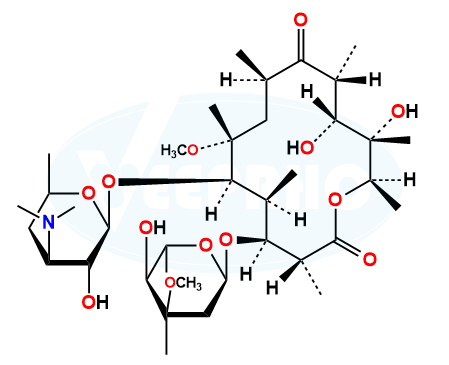
Clarithromycin EP Impurity O
● In Stock
| Catalogue No.: | VL740015 |
|---|---|
| CAS No.: | 127252-80-6 |
| Mol. Formula: | C39H72N2O13 |
| Mol. Weight: | 776.99 g/mol |
For laboratory use only: analytical, development and regulatory purposes. Supplied in mg quantities. Not for human or veterinary use.
Request a quote for a set
- Request quote for this set
All EP impurities of Clarithromycin
16 productsSee the 16 products
- Clarithromycin EP Impurity A VL740014
CAS 124412-58-4 - Clarithromycin EP Impurity B VE009557
CAS 299409-85-1 - Clarithromycin EP Impurity C VL740001
CAS 127253-06-9 - Clarithromycin EP Impurity D VL740002
CAS 101666-68-6 - Clarithromycin EP Impurity E VL740009
CAS 81103-14-2 - Clarithromycin EP Impurity F VL740004
CAS 128940-83-0 - Clarithromycin EP Impurity H VL740006
CAS 127140-69-6 - Clarithromycin EP Impurity J VL740012
CAS 111321-02-9 - Clarithromycin EP Impurity K VL740010
CAS 127157-35-1 - Clarithromycin EP Impurity M VL740003
CAS 127182-43-8 - Clarithromycin EP Impurity O VL740015
CAS 127252-80-6 - Clarithromycin EP Impurity P VL740016
CAS 123967-58-8 - Clarithromycin EP Impurity Q VL740013
CAS 118074-07-0 - Clarithromycin Impurity G VL740008
CAS 127182-44-9 - Clarithromycin Impurity I VL740007
CAS 118058-74-5 - Clarithromycin Impurity N VL740011
CAS 144604-03-5
- Clarithromycin EP Impurity A VL740014
- Request quote for this set
All USP impurities of Clarithromycin
17 productsSee the 17 products
- Clarithromycin EP Impurity A VL740014
CAS 124412-58-4 - Clarithromycin EP Impurity B VE009557
CAS 299409-85-1 - Clarithromycin EP Impurity C VL740001
CAS 127253-06-9 - Clarithromycin EP Impurity D VL740002
CAS 101666-68-6 - Clarithromycin EP Impurity E VL740009
CAS 81103-14-2 - Clarithromycin EP Impurity F VL740004
CAS 128940-83-0 - Clarithromycin EP Impurity H VL740006
CAS 127140-69-6 - Clarithromycin EP Impurity J VL740012
CAS 111321-02-9 - Clarithromycin EP Impurity K VL740010
CAS 127157-35-1 - Clarithromycin EP Impurity L VL740005
CAS 127253-05-8 - Clarithromycin EP Impurity M VL740003
CAS 127182-43-8 - Clarithromycin EP Impurity O VL740015
CAS 127252-80-6 - Clarithromycin EP Impurity P VL740016
CAS 123967-58-8 - Clarithromycin EP Impurity Q VL740013
CAS 118074-07-0 - Clarithromycin Impurity G VL740008
CAS 127182-44-9 - Clarithromycin Impurity I VL740007
CAS 118058-74-5 - Clarithromycin Impurity N VL740011
CAS 144604-03-5
- Clarithromycin EP Impurity A VL740014

Additional information on CAS 127252-80-6
| Parent drug | Clarithromycin |
|---|---|
| Product type | Impurity standards |
| IUPAC name | 6-O-Methylerythromycin A (Z)-9-(O-methyloxime) |
| EP name | Clarithromycin EP Impurity O |
| USP name | Clarithromycin Impurity O |
| CHNS Ratio (%) (calculated) | C 60.29 · H 9.34 · N 3.61 · S 0.00 |
| References | WATANABE, YOSHIAKI, et al. “Chemical Modification of Erythromycins. IX. Selective Methylation at the C-6 Hydroxyl Group of Erythromycin a Oxime Derivatives and Preparation of Clarithromycin.†The Journal of Antibiotics, vol. 46, no. 4, 1993, pp. 647–60, https://doi.org/10.7164/antibiotics.46.647. WASHINGTON, JOHN A., and WALTER R. WILSON. “Erythromycin: A Microbial and Clinical Perspective after 30 Years of Clinical Use (First of Two Parts).†Mayo Clinic Proceedings, vol. 60, no. 3, Mar. 1985, pp. 189–203, https://doi.org/10.1016/s0025-6196(12)60219-5. ‌ |
| Description | Clarithromycin EP Impurity O, also designated Clarithromycin (9Z)-O-Methyloxime, is a semisynthetic macrolide-related process impurity with CAS 127252-80-6. Its molecular formula, C39H72N2O13, and molecular weight of 776.99 g/mol are consistent with oxime formation at the 9-keto function of clarithromycin, typically arising from reaction with hydroxylamine or related carbonyl derivatization pathways during synthesis or stability studies. The oxime functionality alters polarity and chromatographic behavior relative to the parent drug. Characterization and trace quantification generally require LC-MS/MS, high-resolution LC-MS, and orthogonal HPLC-UV or NMR confirmation within impurity profiling programs. |
Request a Quote
"*" indicates required fields
Other products related to Clarithromycin impurities
| Impurity structure | Name of Impurity | Catalogue No. |
|---|---|---|
 | Clarithromycin EP Impurity A | VL740014 |
| Clarithromycin EP Impurity B | VE009557 | |
| Clarithromycin EP Impurity C | VL740001 | |
| Clarithromycin EP Impurity D | VL740002 | |
| Clarithromycin EP Impurity E | VL740009 | |
| Clarithromycin EP Impurity F | VL740004 | |
| Clarithromycin EP Impurity H | VL740006 | |
| Clarithromycin EP Impurity J | VL740012 | |
 | Clarithromycin EP Impurity K | VL740010 |
 | Clarithromycin EP Impurity L | VL740005 |
| Clarithromycin EP Impurity M | VL740003 | |
| Clarithromycin EP Impurity P | VL740016 |