
- 100% accuracy of data
- 24/7 scientific support
- 0% tolerance in quality of product
Mutagenicity assessment (ICH M7)
Potentially mutagenic impurity (ICH M7 Class 1–3).
N-nitroso compound: ICH M7 cohort of concern.Stock Locations
- New Jersey, USA
- Czech Republic, EU
* Stock subject to availability.
Documentation
Includes: HPLC, MASS/LC-MS, 1H NMR, FT-IR, Potency, Structure Elucidation Report (SER), and additional analytical data depending on the product.
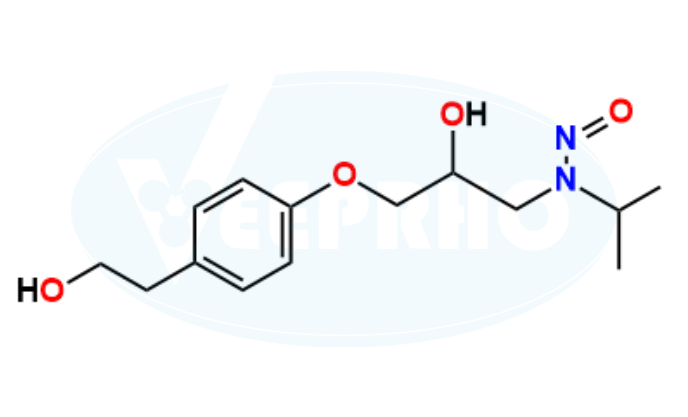
N-Nitroso Metoprolol EP Impurity H
● Under Development
| Catalogue No.: | VE0027736 |
|---|---|
| CAS No.: | N/A |
| Mol. Formula: | C14H22N2O4 |
| Mol. Weight: | 282.34 g/mol |
For laboratory use only: analytical, development and regulatory purposes. Supplied in mg quantities. Not for human or veterinary use.
Request a quote for a set
- Request quote for this set
All nitrosamine impurities of Metoprolol
10 productsSee the 10 products
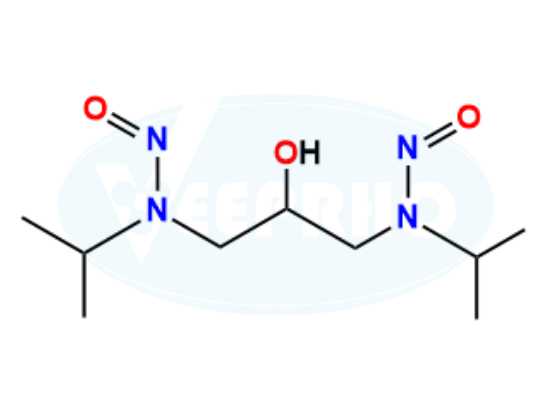
- Dinitroso Metoprolol EP Impurity M VE0027788
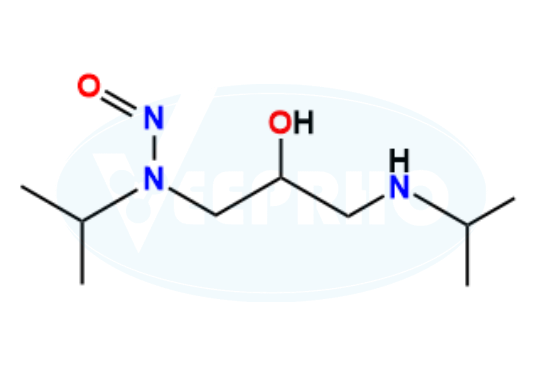
- Mono Nitroso Metoprolol EP Impurity M VE0027784
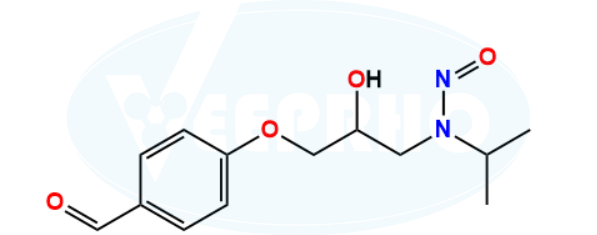
- N- Nitroso Metoprolol Related Compound C VE0020867
- N-Nitroso Metoprolol VE007073
CAS 138768-62-4 - N-Nitroso Metoprolol EP Impurity C VE0024792
- N-Nitroso Metoprolol EP Impurity F VE0024113
- N-Nitroso Metoprolol EP Impurity H VE0027736
- N-Nitroso Metoprolol EP Impurity J VE0027739
- N-Nitroso Metoprolol EP Impurity N VE0027742
- N-Nitroso Metoprolol Related Compound A VE0020868
Additional information on N-Nitroso Metoprolol EP Impurity H
| Parent drug | Metoprolol |
|---|---|
| Product type | Impurity standards, Nitroso impurities |
| IUPAC name | N-(2-hydroxy-3-(4-(2-hydroxyethyl)phenoxy)propyl)-N-isopropylnitrous amide |
| SMILES | O=NN(C(C)C)CC(O)COC1=CC=C(CCO)C=C1 |
| InChI | InChI=1S/C14H22N2O4/c1-11(2)16(15-19)9-13(18)10-20-14-5-3-12(4-6-14)7-8-17/h3-6,11,13,17-18H,7-10H2,1-2H3 |
| InChIKey | ZWMKYWUNIJFDTP-UHFFFAOYSA-N |
| CHNS Ratio (%) (calculated) | C 59.56 · H 7.85 · N 9.92 · S 0.00 |
| Description | N-Nitroso Metoprolol EP Impurity H is a nitrosamine-class impurity observed during metoprolol manufacturing and degradation. As a potential genotoxic impurity it requires strict control through identification of nitrosation pathways, raw material screening, and process parameter optimization. Analytical characterization typically employs sensitive techniques such as GC-MS and LC-MS/MS with validated sample preparation to achieve low ng/g detection limits and quantification limits in compliance with regulatory expectations including ICH M7. Root cause analysis focuses on nitrosating agents, tertiary amine precursors and aqueous acidic conditions. Robust control strategies include reagent selection, scavengers, pH control, and in-process monitoring to mitigate formation risk. |
Request a Quote
"*" indicates required fields
Other products related to Metoprolol and Nitroso impurities
| Impurity structure | Name of Impurity | Catalogue No. |
|---|---|---|
| Betaxolol EP Impurity B (Free Base) | VL103014 | |
| Bisoprolol EP Impurity L | VL191001 | |
| Dinitroso Metoprolol EP Impurity M | VE0027788 | |
| Metoprolol EP Impurity A | VL103001 | |
 | Metoprolol EP Impurity A (HCl Salt) | VE0010647 |
| Metoprolol EP Impurity B | VL103012 | |
| Metoprolol EP Impurity C (Maleate Salt) | VE0021438 | |
| Metoprolol EP Impurity C (Oxalate Salt) | VE0021432 | |
| Metoprolol EP Impurity D | VL103007 | |
| Metoprolol EP Impurity E | VE006518 | |
| Metoprolol EP Impurity F | VL103013 | |
| Metoprolol EP Impurity G | VL103002 |
Show all related products N-Nitroso Metoprolol impurities (8)